
Holiday rentals in Pollença: zones, licences and obligations
Pollença has 2,479 homes with a tourist rental licence, 14.6% of all those in Mallorca, and almost half of them are in the countryside. This is what the rules allow today in each part of the municipality, and what they require of those who already hold a licence.
Where Pollença's holiday homes are
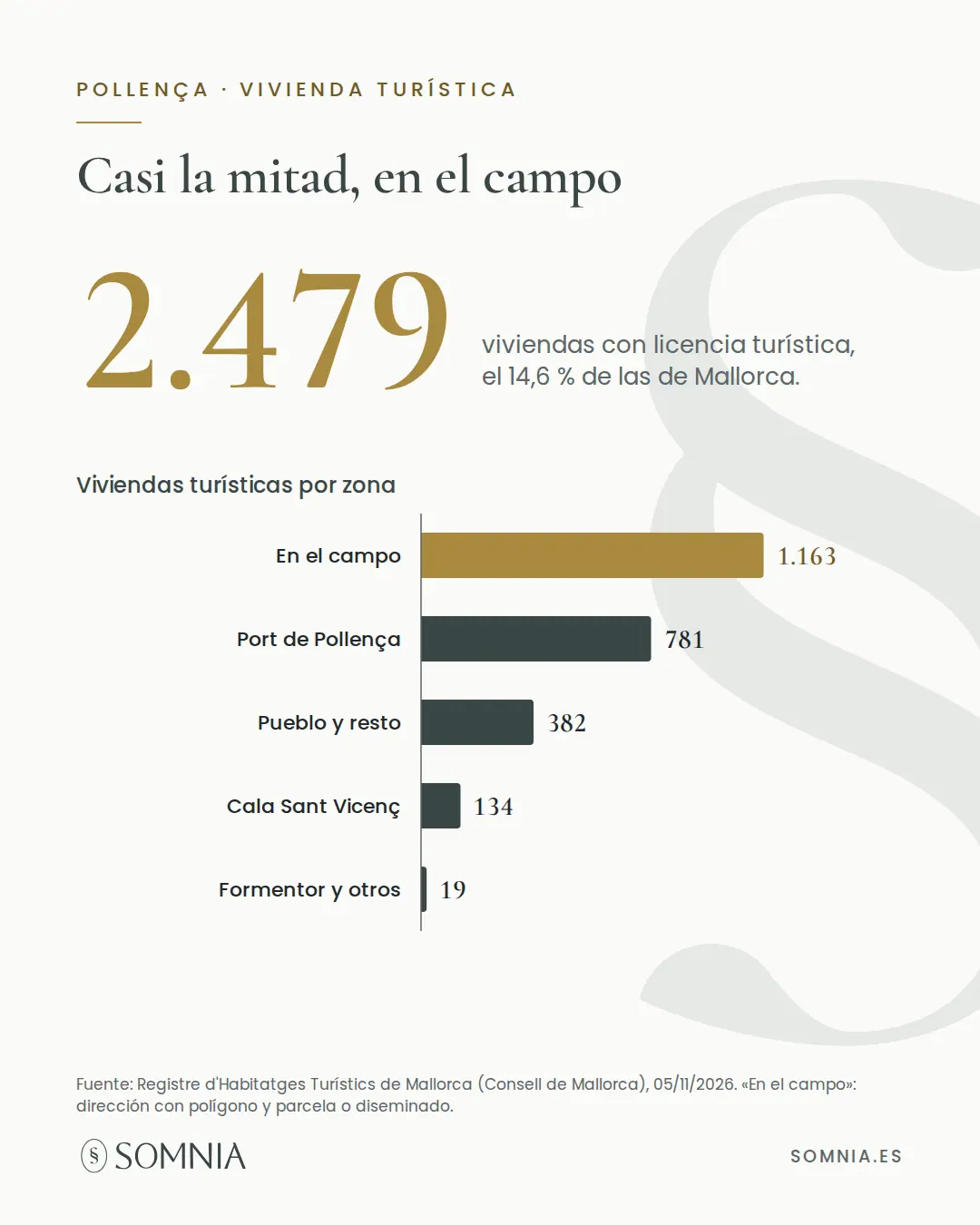
The Consell de Mallorca (Island Council) register lists 2,479 holiday homes with 14,310 bed places in Pollença (5 November 2026). By area, this is how they appear:
- Port de Pollença: 781 homes.
- Cala Sant Vicenç: 134.
- Formentor: 12.
- Others (El Vilar, Aeròdrom Militar and Les Palmeres): 7.
- ‘Pollença’: 1,545. This is the name the register gives to the town and to the countryside of the municipality. 1,163 of them have an address on rural land (suelo rústico) (a polygon and plot reference, or ‘diseminado’, scattered rural dwellings). So, judging by the address, almost half of Pollença's holiday homes are in the countryside: at least 46.9%.
Next door, in Alcúdia, there are 1,425.
By type, there are 1,434 single-family houses (ETV), 489 homes in a community of owners (propiedad horizontal, ETVPL), 442 of them in the Port, 510 with the category ‘habitatge turístic de vacances’ and 21 under the main-residence type (ETV60). The remaining 25 appear in the register as accommodation marketing companies or holiday-home businesses.
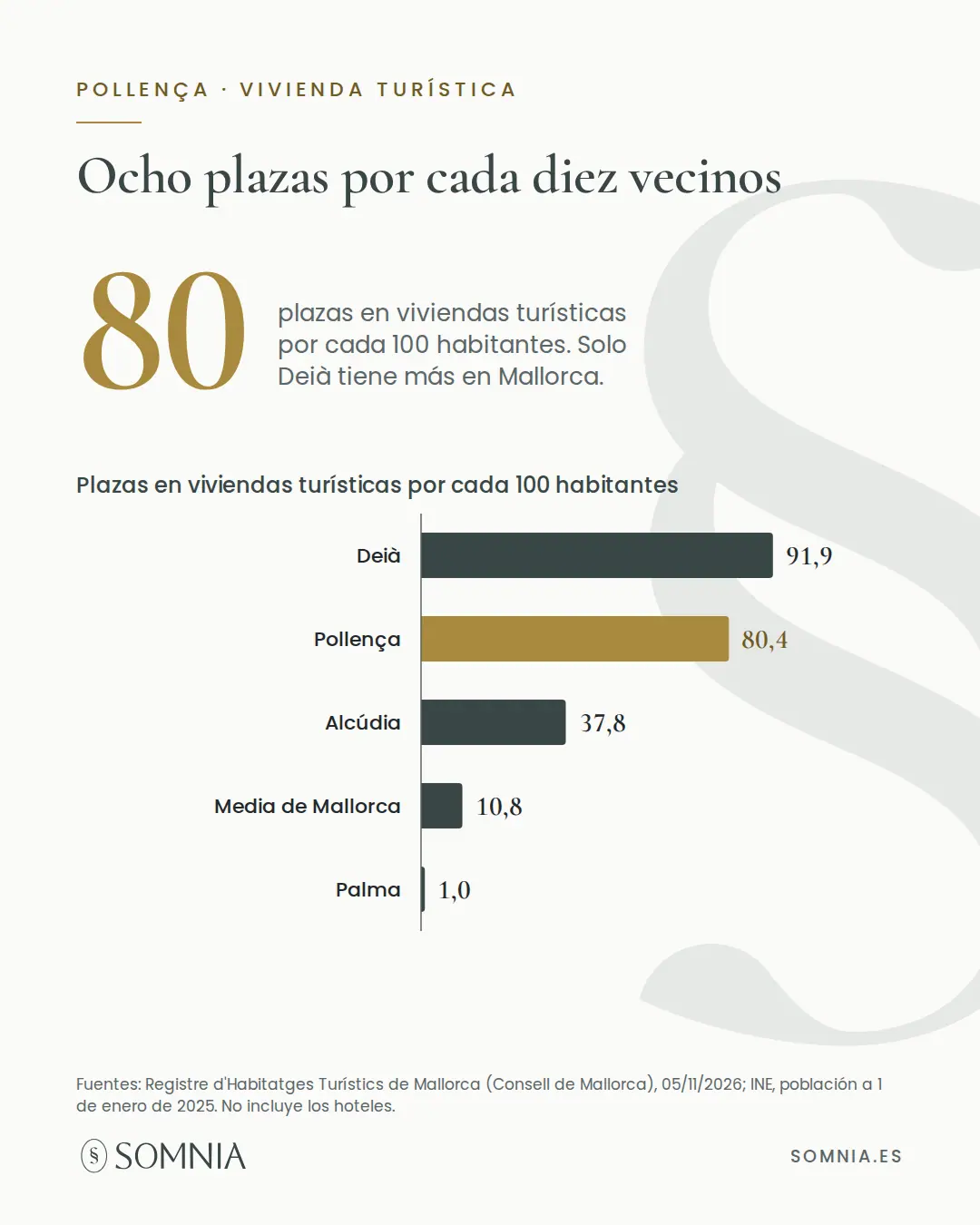
With 17,807 registered residents, that is 80 holiday-home bed places per 100 inhabitants. Pollença is the second-highest municipality in Mallorca by that measure, after Deià, and the island average is 10.8. This count does not include hotels. Bed places from the Consell de Mallorca holiday home register (November 2026) and population from the municipal register (padrón) at 1 January 2025 (INE).
What the rules allow today in each zone
The zoning was set by the Consell de Mallorca in 2018 and completed by the PIAT in 2020:
- Port de Pollença, Cala Sant Vicenç and Formentor are zone Z2.1, the zone for coastal tourist settlements. Single-family houses are allowed all year round, and main residences for up to 60 days. In a community of owners, since 16 April 2025 new registrations have only been allowed for terraced and semi-detached houses, and since 14 June 2026 also for detached houses that share a plot with other buildings.
- Pollença, es Vilà and la Font are zone Z3, vulnerable inland settlements. Only the main residence (ETV60) is allowed, for up to 60 days a year.
- Protected rural land: no new activity is allowed.
- Common rural land: only homes that already existed when the PIAT was initially approved.
For each property, what counts is the municipal suitable-zone certificate (certificado de zona apta), issued by the Ajuntament de Pollença (town council).
On top of that, a new holiday home needs bed places, and in Mallorca they have not been available to buy from the managing body since 11 February 2022. Anyone who doesn't have them can only obtain them in two ways:
- from the temporary pool, made up only of bed places that have been given up, and allocated by lottery under the Consell's rules of March 2026;
- from an owner who deregisters their home and transfers their own bed places, if they bought them at the time.
In practice, almost everything today comes down to looking after the licences that already exist.
If you already have a licence
- Single-family house (ETV): the registration does not expire.
- Flat or terraced house (ETVPL) and main residence (ETV60): these run for periods of five years. Renewal is notified in the month before expiry, and the home must continue to comply, including with the suitable zone. If it is not renewed, it is automatically deregistered and the bed places go back to the pool. This is what most needs watching in the Port, where almost all of the municipality's ETVPLs are.
- The bed places go with the house. If you sell it, the buyer notifies the Consell of the change of holder. If there is a final penalty still to be paid, the change is not processed until it is paid.
- Not marketing it for three years in a row can lead to deregistration by the authorities: the Consell must review these cases before 16 April 2027 (Decreto-ley 4/2025), and the signs it looks for include not filing the tourist tax (Impost sobre estades turístiques) or not reporting guests.
What each stay requires:
- Tourist tax (ecotasa): €2 per person per day. From 1 November to 30 April, €0.50. From the ninth day of the same stay, half. Under-16s do not pay. From 1 December 2026, holiday rentals of 30 nights or fewer carry 10% VAT (IVA), and so does the tax: it forms part of the accommodation's taxable base and is charged at the same rate.
- Reporting guests to the Police (SES.HOSPEDAJES) within 24 hours of arrival.
- The registration number, in every listing.
- A contract that expressly prohibits parties. If a party does take place, you must require the guests to leave the property within 24 hours.
- Stays of 30 nights at most. A tourist stay cannot exceed one month, and the month is exceeded once a stay goes beyond 30 nights (Ley 8/2012, art. 50.13).
Advertising a home without the declaration of commencement of activity (DRIAT) is penalised with a fine of between €30,001 and €50,000 as a serious infringement, and of up to €500,000 if it is very serious (Ley 8/2012, arts. 119 g, 120 and 123).
A country house needs a different kind of care
Almost half of Pollença's holiday homes are fincas and country houses. The care there is different: the water, the garden and the pool, the access tracks, the house shut up in winter and the neighbours on the adjoining fincas. In the town and in the Port, living alongside the neighbours is a matter of the shared staircase and the street: timings, noise, rubbish. The rules set the minimum. What makes a house last, and makes the neighbours glad to have it there, is the day-to-day care.
Frequently asked questions
Can I register a new holiday home in Pollença?
It depends on the zone and on bed places:
- In the Port, Cala Sant Vicenç and Formentor, a single-family house can, and in a community of owners only a terraced or semi-detached house, or a detached house that shares a plot.
- In the town, es Vilà and la Font, only the main residence, for up to 60 days.
- On protected rural land, nothing new.
In every case you need the Ajuntament's suitable-zone certificate and bed places. Since 2022 bed places cannot be bought from the managing body: what remains is the temporary pool, allocated by lottery, and the bed places an owner transfers when deregistering their home.
I have a licensed flat in the Port. Do I have to renew it?
Yes. Those in a community of owners (ETVPL) last five years. Renewal is notified in the month before expiry, and the home must continue to comply, including with the suitable zone. If it is not renewed in time, it is automatically deregistered and the bed places go back to the pool.
What happens to the licence if I sell the house?
The bed places are tied to the property and pass with it. The new owner notifies the Consell of the change of holder. If there is a final penalty still to be paid, the change is not processed until it is paid.
How much is the tourist tax in winter?
From 1 November to 30 April, €0.50 per person per day in a holiday home. The rest of the year, €2. From the ninth day of the same stay, half is paid, and under-16s do not pay (Ley 2/2016, arts. 5 and 13). It is charged and paid over by whoever operates the property.
From 1 December 2026, holiday rentals of homes for stays of 30 nights or fewer carry 10% VAT (Real Decreto-ley 29/2026, art. 7, ratified on 12 November 2026). For those stays, the tax carries the same 10%, because it forms part of the accommodation's taxable base.
Can I let the house I live in for a few weeks?
Yes, under the main-residence type (ETV60). It has to be done by a private individual (persona física), in their habitual residence, for up to 60 days a year and in whole months, stated in the declaration. It runs for renewable five-year periods and is allowed in all of Pollença's suitable zones, including the town.
From 1 December
Your holiday rental now carries 10% VAT
An invoice for every stay of 30 nights or fewer, VAT registration (form 036) and a return every quarter, even in a quarter when you receive nothing. And if you don't adjust your price, much of the VAT comes out of your own pocket.
We'll explain it in 15 minutes, with no obligation.
Let's talk What changes, with the legislation in front of us → (in Spanish)
Get your home valued with your area's data
Tell us the basics and we will reply with what we see in your area: what rents, when and at what price. No commitment and no sales calls.
How we work Holiday home and villa management in Mallorca →
Sources
- Registre d'Habitatges Turístics de Mallorca (Mallorca holiday home register; Consell de Mallorca, open data), downloaded on 5 November 2026
- INE (Spanish National Statistics Institute), official population figures at 1 January 2025, table 2860 (Real Decreto 1117/2025, BOE 11 December 2025)
- Ley 8/2012, de 19 de julio, del turismo de las Illes Balears (Balearic Tourism Act), consolidated text, updated to 13 June 2026
- Delimitación provisional de las zonas aptas para estancias turísticas en viviendas (provisional delimitation of the zones suitable for tourist stays in homes), Consell de Mallorca (BOIB 93, 28 July 2018)
- Plan de Intervención en Ámbitos Turísticos (PIAT) de Mallorca (Mallorca tourist areas plan), final approval on 9 July 2020 (BOIB 126, 16 July 2020)
- Ley 3/2022, de 15 de junio, disposición adicional 1.ª (first additional provision) (BOIB 79, 18 June 2022)
- Decreto-ley 4/2025, de 11 de abril, disposición adicional 1.ª (BOIB 46, 15 April 2025) · review of homes not marketed for three years, with a deadline of 16 April 2027; deregistration ‘may be agreed’ by the authorities (Ley 8/2012, art. 85.2)
- Decreto-ley 4/2025, de 11 de abril, disposición adicional 2.ª (second additional provision) (BOIB 46, 15 April 2025), as worded by Ley 4/2026, de 11 de junio (BOIB 74, 13 June 2026)
- Ley 1/2025, de 13 de junio, de prevención de fiestas en viviendas turísticas (prevention of parties in holiday homes)
- Ley 2/2016, de 30 de marzo, del impuesto sobre estancias turísticas (tourist tax act), arts. 5 and 13
- Real Decreto 933/2021, de 26 de octubre (BOE 27 October 2021)
- Ley 37/1992, del IVA (VAT Act), art. 78.Dos.4.º: the tax forms part of the VAT base of the accommodation
- Real Decreto-ley 29/2026, art. 7, consolidated text, effective from 1 December 2026, and its ratification (BOE 13 November 2026)
- Rules of the CBAT temporary pool of bed places (BOIB 33, 14 March 2026)